
Unveiling the Etruscans: Italy’s Mysterious Ancient Power

The ancient city of Caere, now modern Cerveteri, Italy, holds the enduring legacy of the Etruscans, a civilization as influential as it was enigmatic. The 1836 discovery of the Regolini-Galassi tomb, revealing the rich burial of a woman and the ashes of a man, underscored the profound mysteries surrounding this people. Their origins, language, and culture continue to captivate researchers, offering a glimpse into a powerful society that deeply shaped early Rome.
Unveiling the Etruscans
The Etruscan civilization, despite extensive archaeological efforts, remains largely shrouded in mystery, particularly regarding their linguistic roots. Unlike other languages of the Italian peninsula, Etruscan appears unrelated to Italic tongues, hinting at a potential connection to ancient Anatolian languages. This linguistic anomaly fuels ongoing debates about their origins.
Origins: Indigenous or Migrant?
The prevailing theories on Etruscan origins are diverse. The Greek historian **Herodotus** posited a Lydian origin from Anatolia, suggesting a migration westward led by figures like Tarconte, the mythical founder of Tarquinia. Other classical writers, such as Helanicus of Lesbos, linked them to the Pelasgians, another Anatolian people. Conversely, some ancient authors argued for an indigenous Italic origin. The inability to fully decipher the **Etruscan language** is a major impediment to resolving these debates. Scholars eagerly await an “Etruscan Rosetta Stone” — a bilingual text that could unlock the meaning of their written records, much like Champollion’s discovery for Egyptian hieroglyphs. While the alphabet, derived from Western Greek, is readable, the meaning of the words remains largely unknown.
The Etruscan League: A Powerful Confederation
Evidence suggests Etruscans were settled in Italy by the 12th century BC, initially inhabiting simple, fortified wooden settlements. Their prosperity rapidly grew through the exploitation of abundant mineral resources like **copper, lead, iron, and tin**. These metals were crafted into valuable goods for trade, fostering the rise of a powerful, wealthy elite who controlled both internal and external politics. The civilization was organized as a confederation of strong, independent city-states. Prominent cities included Tarquinia and Caere (modern Cerveteri), where the aristocracy commissioned **impressive tombs and tumuli filled with lavish grave goods**, testifying to their immense wealth and sophisticated culture.
Etruscan Life and Death
Much of our understanding of the Etruscans comes from their elaborate funerary art and rituals, ranging from early monumental tumuli to later Hellenic-influenced tombs. Their culture was profoundly religious and deeply connected to their ancestors.
Elaborate Funerary Practices
Etruscan death rites were complex and sophisticated, often involving **lavish banquets held within the tombs themselves**, in designated chambers. A prime example is the Regolini-Galassi tomb in Cerveteri’s Necropolis del Sorbo, a tumulus with a 48-meter diameter. A long dromos (antechamber) led to the burial chamber of **Larthia**, an Etruscan princess from the wealthy Velthus aristocratic family, identified by inscriptions on funerary patera. Larthia’s body was discovered adorned with gold foils and intricate jewelry, showcasing the Etruscans’ refined, Oriental-influenced goldsmithing. Adjacent chambers provided evidence of traditional funerary banquets held after the burial, before the tomb was sealed. A small window in a partition allowed observation of the treasures accompanying the deceased. Intriguingly, figurines representing professional mourners were found among Larthia’s grave goods, perhaps intended to mourn the princess for eternity. Etruscan funerary rites blended **grief with celebration**, featuring professional mourners, but also beautiful music and opulent feasts in honor of the dead.
Cultural Intersections
Etruscan culture absorbed significant influences from its Hellenic neighbors and later, from its Roman conquerors, though this cultural exchange was profoundly bidirectional. Notably, some of the **last Roman kings were of Etruscan origin**, illustrating constant cross-cultural dialogue.
Greco-Roman Influences
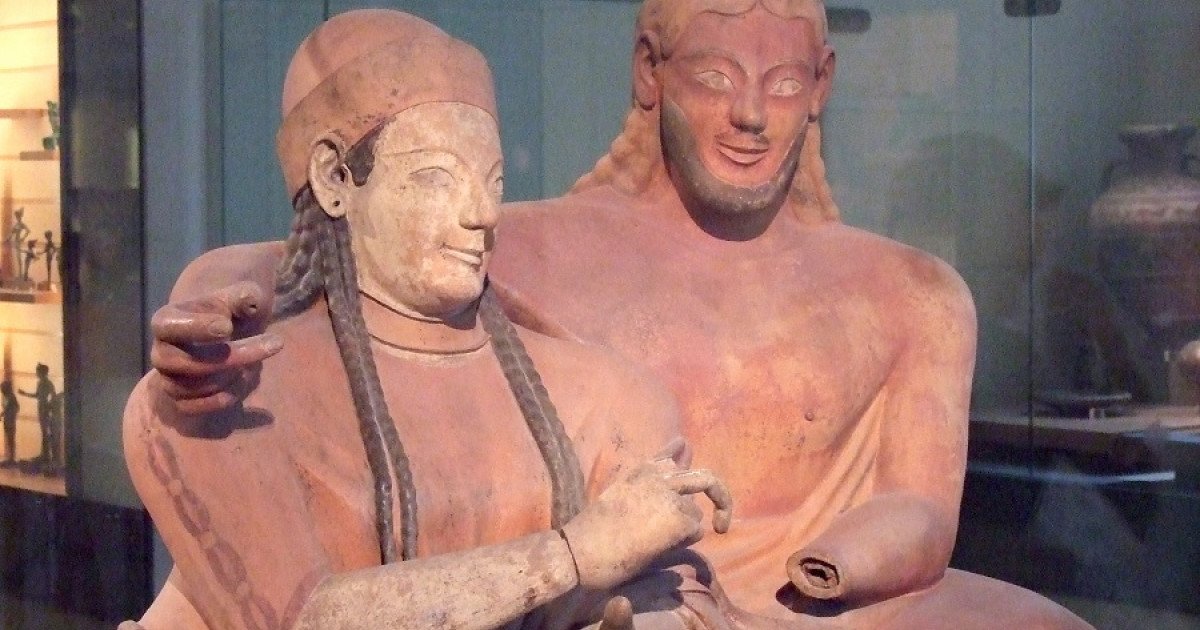
The impact of Greek art is particularly evident in Etruscan sculpture from the 7th and 6th centuries BC. These works adopted Greek sculptural styles, characterized by almond-shaped eyes, geometrically styled hair, and the enigmatic “Etruscan smile,” akin to the **kouroi and korai** of the Greek Archaic period. A prime example is the **Sarcophagus of the Spouses** from the Cerveteri Necropolis, depicting a man and a woman reclining on a luxurious Greek *kliné* (dining couch), conversing animatedly. The woman pours perfume into the man’s hand, who leans on a wineskin – highlighting **perfume and wine** as essential elements of Etruscan banquets, demonstrating that hedonism and death were not contradictory in their culture.
The Etruscan pantheon also reflects clear Greek and later Roman influences. While the Etruscans had their own indigenous gods, including the superior dii involuti and lesser dii consents who communicated with humans, over centuries, these minor deities acquired Greek characteristics and were plastically represented with Greek appearances. Thus, Tinia, the principal Etruscan dii consents, was later identified with Zeus; Aplu, of Akkadian origin, became Apollo; and Menrva (root of the Roman Minerva) was equated with Athena. Priests played a crucial role in interpreting divine signs, such as the three distinct types of lightning cast by Tinia-Zeus, each with its own specific meaning.
The Decline of Etruscan Civilization
The dominance among Etruscan city-states shifted over time, with Tarquinia initially leading in the 7th century BC, followed by Caere’s preeminence for about a century. Later, cities like Vulci, renowned for bronze and stone sculpture workshops, and Veii, known for terracotta sculpture, rose to prominence. While Etruscan cities initially held sway over a fledgling Rome, by the late 5th century BC, the balance of power shifted decisively. **Rome began its relentless expansion across the Italian peninsula**, subjugating peoples including the Sabines, Umbrians, Ligurians, and, eventually, the Etruscans. Despite their conquest, many elements of Etruscan culture were assimilated into Roman civilization, ensuring their enduring legacy.